

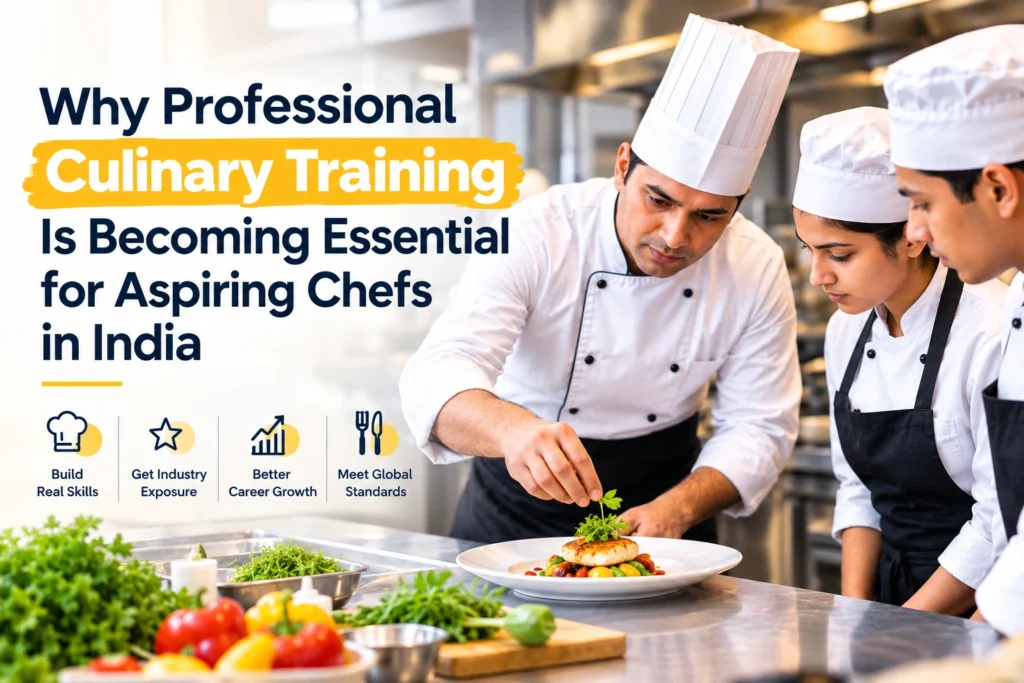
Why Professional Culinary Training Is Becoming Essential for Aspiring Chefs in India
There was a time when becoming a chef was mostly associated with knowing how to cook well. Today that is just one part of the job. Professional kitchens have become more organized, customers expect consistency and food businesses are operating at a much larger scale. A chef might be working in a hotel one day or a restaurant or catering business the next. In each setting, knowing recipes is really useful but knowing how to work effectively, maintain hygiene, manage ingredients, and deliver the same standard repeatedly matters just as much. According to the NRAI India Food Services Report 2024, the industry was valued at around ₹5.69 lakh crore in FY24 and is projected to reach approximately ₹7.76 lakh crore by FY28. If you are considering a career in food then professional culinary training becomes more relevant for you than just learning a collection of recipes. India’s expanding hospitality industry is creating new opportunities The growth of food services is happening alongside a wider expansion in India’s hospitality sector. Hotels, restaurants and other food businesses are developing in established metros and emerging cities. Tourism, weddings, business travel and domestic leisure travel are also supporting demand for hospitality services. If you are an aspiring chef in India, the important point is that the career landscape is becoming broader. A culinary professional is no longer limited to the traditional route of joining a hotel kitchen and staying only on one career track. Cooking skills alone are no longer enough Knowing how to make a good dish at home and working as a professional chef are 2 very different things. At home you can take your time changing the seasoning halfway through cooking or make a different portion for each person. A professional kitchen doesn’t work that way. A chef might have to prepare the same dish repeatedly while maintaining the same taste and portion size. Ingredients need to be prepared before service, equipment needs to be used correctly, food needs to be stored safely and orders need to move through the kitchen without unnecessary delays. There is also the commercial side of cooking. Food costs money, ingredients can be wasted and portions affect margins. As a chef you need to understand these things while still focusing on the food. There is a difference between just knowing how to cook and knowing how to function in a professional kitchen. According to IBEF, India’s hotel industry is expected to record 9–12% year-on-year revenue growth in FY26, with demand supported by domestic leisure travel, MICE activity, weddings and corporate travel. What professional culinary training actually teaches A well structured culinary arts course in India should cover much more than recipes. Cooking fundamentals As a student you can start with basics that you will continue using throughout your career. Knife skills, ingredient preparation, cooking methods and proper handling of ingredients are all part of the foundation. This might sound very simple but getting the basics right makes more advanced cooking much easier. Indian and international cuisines Professional training can also expose you to different cuisines and techniques. This helps you understand how cooking methods, ingredients, and flavor combinations change from one cuisine to another. Food safety and hygiene A professional kitchen has strict responsibilities when it comes to food safety. As a student, you need to understand storage temperature control, sanitation and safe ingredient handling. These are everyday kitchen practices rather than subjects that can be simply memorized. Kitchen operations There is a lot happening behind the scenes during service. Workstation organization, timing, communication and teamwork all affect how smoothly a kitchen operates. Training gives you an opportunity to understand the systems before entering a busy professional kitchen. Presentation The way food is presented matters. You can learn about plating portioning and consistency so that a dish does not look completely different every time it leaves the kitchen. Commercial understanding Professional chefs also need to have some understanding of food costing and waste. Reducing unnecessary waste and using ingredients effectively can make a real difference to the food business. Professional behavior Working in a kitchen can be demanding. Punctuality, discipline and ability to stay focused during busy times are all part of becoming a reliable member of a kitchen team. Why is training more important in culinary education? In culinary education it’s difficult to learn entirely from a classroom. You can watch a chef demonstrate how to cut vegetables or prepare a sauce, but the real learning happens when you pick up the knife and do it yourself. The first attempt might be slow. The second might be better. After repeated practice, the movement becomes more natural. This is why practical training matters when comparing chef training in India. Students need opportunities to work with professional equipment, follow recipes, and deal with mistakes while they still have instructors around to guide them. The point is not the percentage. It is the opportunity to practice professional kitchen routines instead of just learning about them. Culinary careers now go beyond hotel kitchens When you learn about a chef ‘s career, you just picture a hotel kitchen. Hotels are certainly one option, but the food industry has become much broader. Depending on their training and experience, culinary professionals can explore roles in: Some professionals eventually move into food entrepreneurship while others specialize in areas like pastry bakery Indian cuisine or international cuisines. The variety also means students should not choose a course simply because it has a check in the title. The curriculum should give them enough exposure to understand major interests and strengths in life. What aspiring chefs should look for in a culinary program? Choosing a culinary institute in Delhi or elsewhere in India requires a little research. You need to start by looking at the practical components. How much time do students spend in kitchens? What equipment is available? Then let’s set the curriculum. A useful program should cover cooking fundamentals, food safety, kitchen operations presentation, not anything focused only on recipes. It is also