

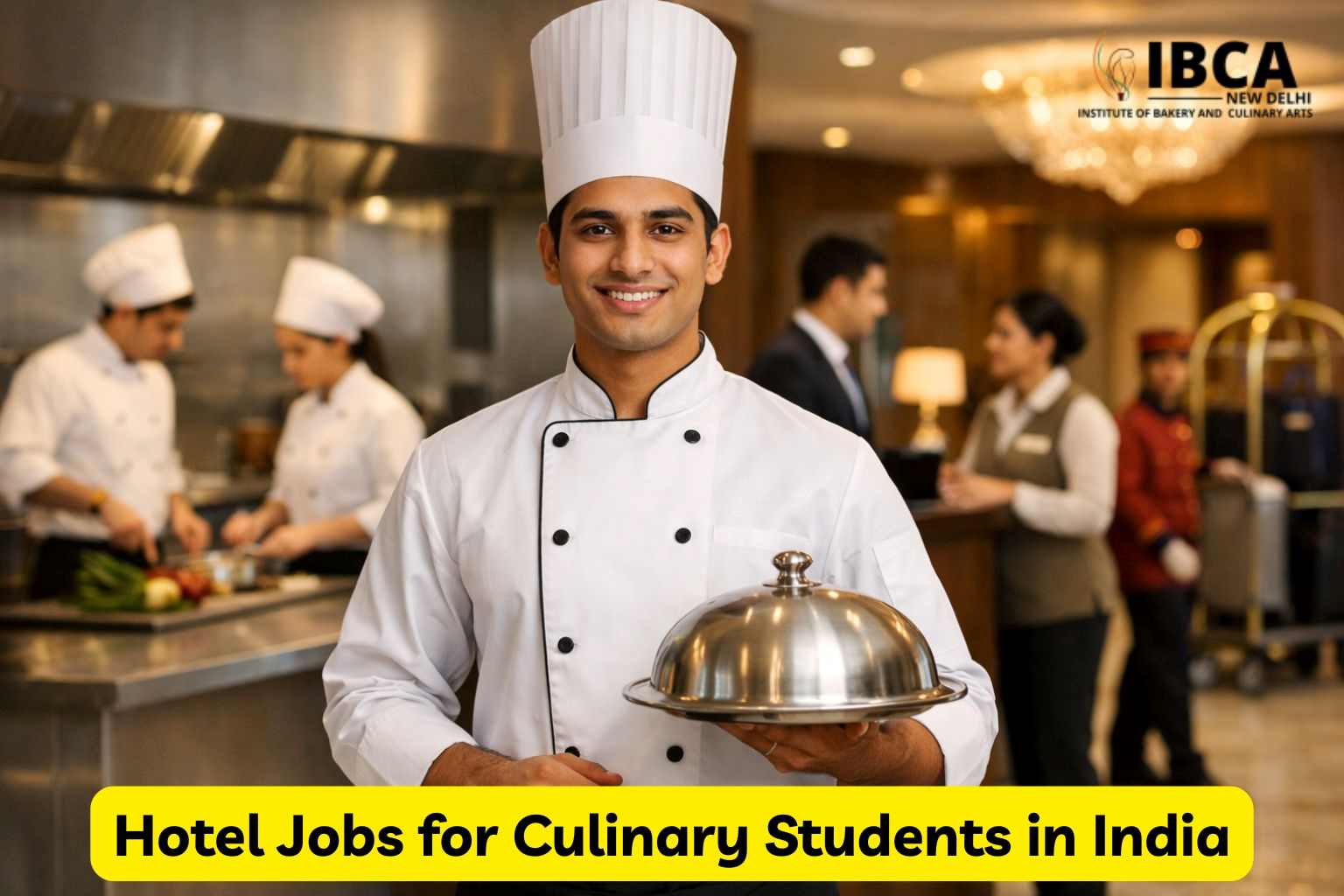
Nowadays, everyone has access to almost everything, as we all have the internet. Due to increasing social media connectivity, people are exposed to different cultures and cuisines. Most people demand different cuisines in various restaurants and hotels. For that reason, the demand for trained chefs keeps increasing in hotels and restaurants that have knowledge of different cuisines, their ingredients, and techniques of preparation.
Any chef, for the sake of skill development, must have formal culinary training, which teaches them the kitchen work culture, food safety and hygiene, as well as time management and teamwork. But there are some misunderstandings among students about how culinary students get hotel jobs in India. People think they will earn a high salary from the first day, working hours will be less, and they will start working as a chef immediately, but it’s not like that. This is done with time as per professional progression in your skills through working hours. Many students choose a Diploma in Culinary Arts to gain professional kitchen training and understand how hotel kitchens operate in the hospitality industry.
In this guide, we will cover how students get hotel jobs in India and let you know about the skills, training, and career path in culinary arts.
Understanding Hotel & Restaurant Job Opportunities in India
The places where you are going to work as a chef after culinary training depend on your performance and the skills you have developed. Accordingly, you can get recruited in hotels and restaurants, which will let you know how culinary students get hotel jobs in India. Students who complete a Diploma in Cooking often gain the practical knowledge required to start their careers in professional hotel kitchens.
Types of workplaces where culinary graduates can give preference:
5-Star Luxury Hotels
These hotels follow very strict hygiene and discipline standards. They are a strong base for beginners. These hotel kitchens have multiple food cuisines such as Indian, Continental, Dessert, etc.
Boutique hotels and mid-scale hotels
In these hotels, food delivery is done with a small team. Working conditions are more flexible and not very strict.
Cloud kitchens and delivery-focused businesses
These kitchens cook food mainly for online food delivery. The working speed is high, with no more detailing required in food related to plating.
Quick service restaurants
In these restaurants, students or employees have fixed roles and are required to cook standardized recipes.
To enhance the skills in culinary arts, you should work on standards to improve speed and time management. Working in a team does not develop creativity at the initial stage. Therefore, culinary practice helps you grow gradually.
Kitchen Training
- Bakery Assistant
- Cloud cooking person
Comparison Between Hotel kitchens and Standalone restaurants
Hotel Kitchens | Standalone restaurants |
Require a high level of specialization and professional skills. | Smaller in size, but requires the ability to work with a team flexibly. |
High workload during events and banquets | Workload is high during peak business periods. |
Multiple cuisines are offered, and chefs must have detailed knowledge. | Flexibility to focus on and master one type of cuisine or food. |
How Culinary Students Get Hotel Jobs in India (Step-by-Step Process)
Culinary students need to understand how to reach their goals and how to be professional. They should start learning from the basics.
Step 1 – Professional Culinary Training
To achieve professional-level skill development, self-learning alone is not enough. Students need formal training that helps them understand ingredients, time management, and kitchen hygiene. For this, structured courses are required, where students gain a basic understanding and learn kitchen management techniques.
Step 2 – Practical Kitchen Exposure
These courses provide exposure to live kitchen practices and teach students how to handle kitchen operations. Every student is trained to handle real equipment and work under pressure.
Step 3 – Internship & Industry Exposure
After completing the course, internships in hotels are required to gain practical training. This training improves culinary skills. Through internships, students learn discipline, research, and the work culture of hotels and restaurants. During internships, the chances of getting a job in kitchens, restaurants, and hotels become easier.
Step 4 – Placement Support & Interviews
Within the course, students receive help from culinary training institutes on how to design their resumes. The culinary training institute provides proper training for kitchen tests and prepares students for real situations they may face during kitchen interviews or tests in restaurants and hotels. The training institute acts as a guide for students to help them grow in their profession.
Must Read This : International Culinary Opportunities After Graduating from Chef IBCA
Skills Required for Hotel and Restaurant Jobs
Students need to understand how culinary students get hotel jobs in India and jobs in hotels and restaurants. You need to develop several skills that are essential for the hospitality industry. These skills can be broadly divided into two types.
Technical (Hard) Skills
Hard skills are technical skills related to kitchen operations. These include kitchen management, understanding kitchen hygiene, and food safety. The major hard skills required are:
- Food Preparation: Understanding ingredients and food science to enhance flavours.
- Baking Fundamentals: Knowledge of basic baking techniquesis required for baked dishes.
- Knife Skills: Proper knife-handling skills for efficient and safe food preparation.
- Kitchen Hygiene and Food Safety: Understanding the different measures required to maintain kitchen hygiene and food safety.
- Speed Management: Ability to manage speed without compromising the taste and quality of food.
Soft Skills Hotels Look for
Soft skills are personal and interpersonal skills that hotels look for, such as:
- Discipline and Punctuality: Being disciplined and punctual at work.
- Teamwork Under Pressure: Ability to work effectively as a team member, even under pressure.
- Communication Skills: Good communication skills to ensure customer satisfaction.
- Learning Attitude: The student must have the ability and willingness to learn continuously.
Role of Culinary Institutes in Job Preparation
The institution of culinary studies, Chef IBCA, gives people proper opportunities for skill development in this field to get hired for jobs as early as possible. In this institute, students get several benefits.
Students get to work with an industry-aligned curriculum. The teachers who teach students are well-experienced chefs who guide students and help them to become good professionals in their field.
Students will get proper practical training in a work-oriented environment, which helps them to gain experience and understand how to work in hotel and restaurant kitchens.
In the Culinary institution Chef IBCA, they also conduct mock interviews to help students’ to improve and build confidence and skills.
They also provide good career guidance based on the skills students have developed.
Career Path After Getting a Hotel Job
A culinary career path depends on how skilled you are in your work. According to your experience and learning, your salary will keep increasing.
There is step-by-step sectional growth in this profession. First, you work as a Commis Chef, then progress to CDP (Chef de Partie), then Sous Chef, and finally Head Chef, who handles the entire kitchen.
The growth timeline is not guaranteed. It completely depends on your skill level, learning capacity, and experience in different cuisines. With time, your cooking skills and kitchen management abilities grow, helping you reach a professional level.
As your skills continue to develop, your salary will also keep increasing. With professional-level skill development and years of experience, you can earn a good income.
There are good opportunities in kitchen management. The culinary field has high demand not only in India but also abroad. Based on your performance, the training institute will help and guide you in getting placed in the right position.
Common Mistakes Culinary Students Make While Applying for Hotel Jobs
Many freshers make common mistakes that become barriers to getting job opportunities in hotels and restaurants.
- Ignoring real-time kitchen experience
Students ignore learning real-time experience of kitchen working pressure. They avoid developing practical skills.
- Not taking training seriously during internships.
During internships, they do not take the training and work practice seriously, because of which they generally do not get real-life experience.
- Unrealistic expectations
They have unrealistic expectations regarding working hours and workload, due to which they lose interest in work.
- Choosing an institute without industry exposure
They join institutes that do not provide proper industry exposure. As a result, they are not ready to work properly, and without industry exposure, they have little knowledge of how the industry actually works.
How to Increase Your Chances of Getting Hired by Hotels
For getting an early entry into hotels or restaurants, there is a need to work on several aspects, such as:
- Choose the right institute according to your interests and the area in which you have good skills.
- During training, focus only on skill development, not just on certificates, because you are mostly judged and trained according to your skills.
- Be like a child who is open to learning and has the interest to work more to learn new skills.
- Develop a disciplined temperament and be punctual at all times.
Is a Professional Culinary Course Necessary for Hotel Jobs?
There are many doubts among freshers regarding the necessity of a professional culinary course for hotel jobs. These doubts can be cleared by the following points.
There is a huge difference between trained and untrained candidates.
Comparison Between Trained and Untrained Candidates
Trained Candidates | Untrained Candidates |
Know kitchen fundamentals. | Lacks proper cooking knowledge. |
Have practical working experience in commercial kitchens and with kitchen equipment. | Have no understanding of commercial kitchen management and equipment operation. |
Understand time management, workflow, and how to manage pressure. | Have little experience in time management and handling work pressure. |
Conclusion
If you are looking for job opportunities in culinary hotels and restaurants, you must have practical-level training. Practical training helps in skill development and teaches you how to work in a hotel kitchen. These career opportunities will help you earn a higher salary over time as your skills develop to a professional level through years of experience.
For proper training in a culinary course, you should take the first step by choosing a well-recognized institute that prepares you for job opportunities. Such institutes make you job-ready. For the best guidance in culinary arts, Chef IBCA is one of the recommended institutes for culinary training in India. You can take our course, and after graduating from our institute, culinary students get hotel jobs in India.
Choosing the best culinary institute in India can make a big difference in building a successful career in the hospitality industry.
FAQs
How long does it take to get a hotel job after culinary training?
It all depends on the learning and training skills of the trainee. If you are well-trained and have working experience through internships, then the chances of early hiring are high.
Do hotels hire fresh culinary students?
Yes, they hire freshers who have well-trained skills in culinary arts.
Are internships mandatory for hotel jobs?
Yes, because internships give you real-time practical experience. Through internships, you get exposure to working conditions within a hotel kitchen and learn how to manage it.
Can bakery students get hotel jobs?
Yes, a bakery student can also get hotel jobs as a specialist in baking or in different types of bakery products.
What qualifications do hotels prefer for chefs?
Hotels require a certificate or degree in culinary arts, along with qualifying kitchen tests and internship certificates that provide industrial exposure.